Our Reach
Pan-African digital ecosystem
Serving members across 121 countries
Community Contact
+233 0598881959
Pan-African digital ecosystem
Serving members across 121 countries
+233 0598881959








 by MasterIsaac
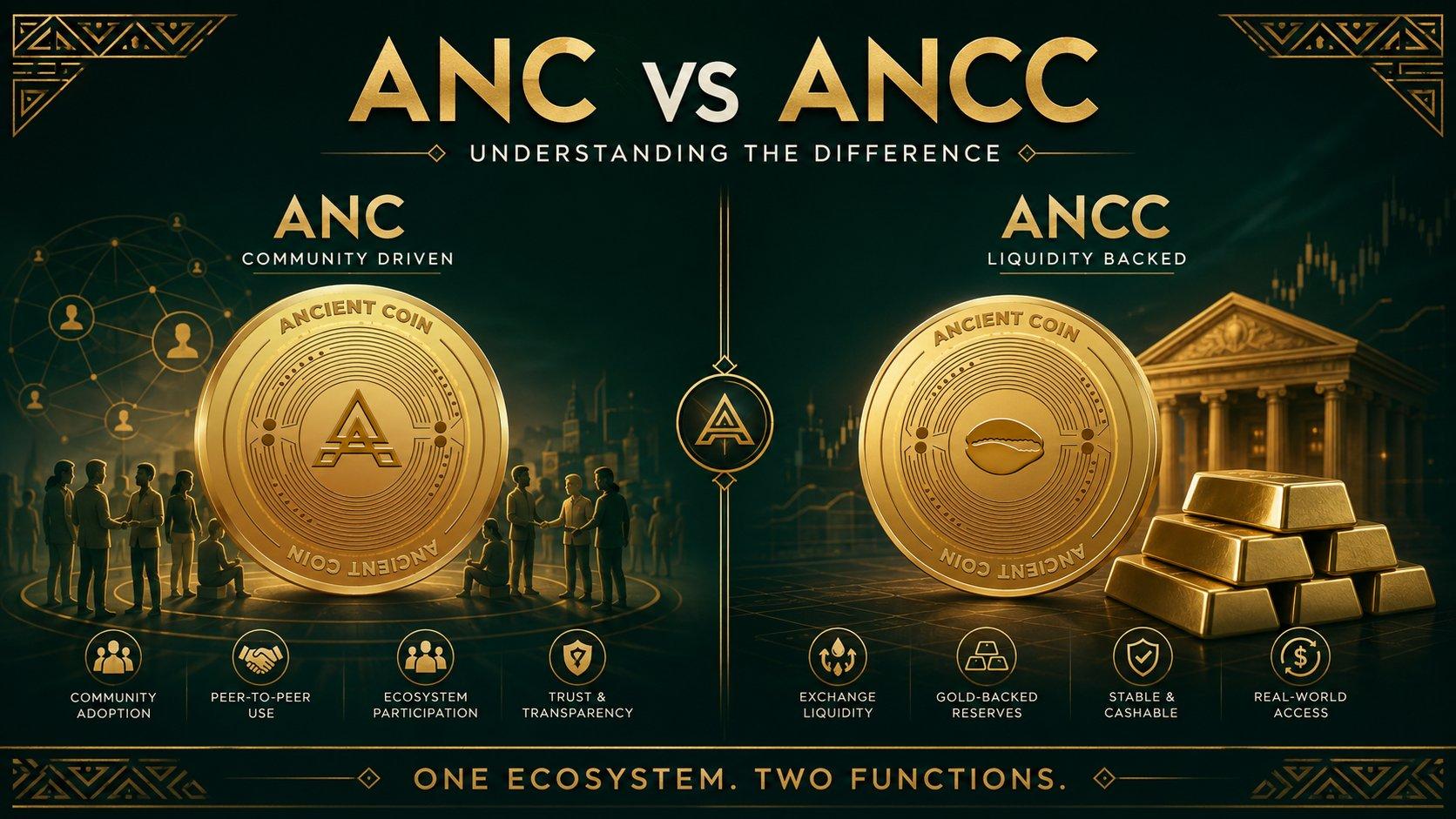
Since the formal Announcement of Ancient Coin Cashable (ANCC), questions have continued to arise about the distinction between Ancient Coin, abbreviated as ANC, and Ancient Coin Cashable, abbreviated as ANCC.
Some members understand both coins clearly, while others remain uncertain about their origins, purposes, liquidity structures, and future relationship. This article has therefore been prepared to set the record straight.
It explains how Ancient Coin emerged, why the original distribution strategy had to be revised, why Ancient Coin Cashable was introduced, what the future holds for existing ANC holders, and what responsibilities now rest upon pioneers, distributors, country leaders, and new members of the Ancient Society community.
Ancient Society Was Established as a Community Project
Ancient Society was formally announced on 1 November 2021, following approximately two to three years of research, planning, structural design, and initial development.
From the beginning, Ancient Society was conceived as a community-owned Pan-African project. It was not designed to be owned, financed, or controlled by one individual or a small group of private investors.
Its strength, survival, and expansion were intended to depend on the collective commitment of the people who form the Ancient Society community.
However, a project of this magnitude required substantial resources. Funds were needed to manage administrative affairs, build the Ancient Society website, develop the Ancient blockchain, finance technical work, and establish the foundations of the wider Ancient ecosystem.
To mobilize the initial resources required for this work, the administration created a token on the Binance Blockchain known as LioEagle, abbreviated as LIOE.
The name “LioEagle” was formed by combining the lion and the eagle, the two principal totems of Ancient Society.
LIOE served as an early fundraising instrument for the development of the Ancient Society project. Those who acquired it were informed that they would eventually be able to exchange their LIOE tokens for Ancient Coin once the Ancient Blockchain became operational.
The Introduction of Ancient Coin
In May 2022, the Ancient blockchain was released for its Initial Coin Offering, commonly known as an ICO.
As promised, LIOE holders were given the opportunity to exchange their tokens for Ancient Coin. The conversion was not conducted at a one-to-one ratio. Instead, twenty LIOE tokens were exchanged for one Ancient Coin.
The conversion process was successful, and almost all eligible LIOE holders received their corresponding amount of Ancient Coin.
Following the ICO, the administration adopted a community-based distribution strategy.
Early holders and distributors had acquired Ancient Coin at a relatively low price. They were therefore expected to help distribute the coin to a much wider population, educate new adopters, create public awareness, inspire confidence, and generate momentum around the project.
This strategy was important because Ancient Coin had been designed around a distinctive value model.
nlike many conventional cryptocurrencies, the value of Ancient Coin was not intended to depend exclusively on the amount of liquidity available on an exchange. Its value was designed to grow through adoption, trust, utility, and the number of people using and accepting the coin.
The more people who adopted and used Ancient Coin, the stronger its economic foundation was expected to become.
However, the original distribution strategy did not produce the intended outcome.
Why the Original Strategy Had to Be Revised
Several major factors affected the original Ancient Coin distribution model.
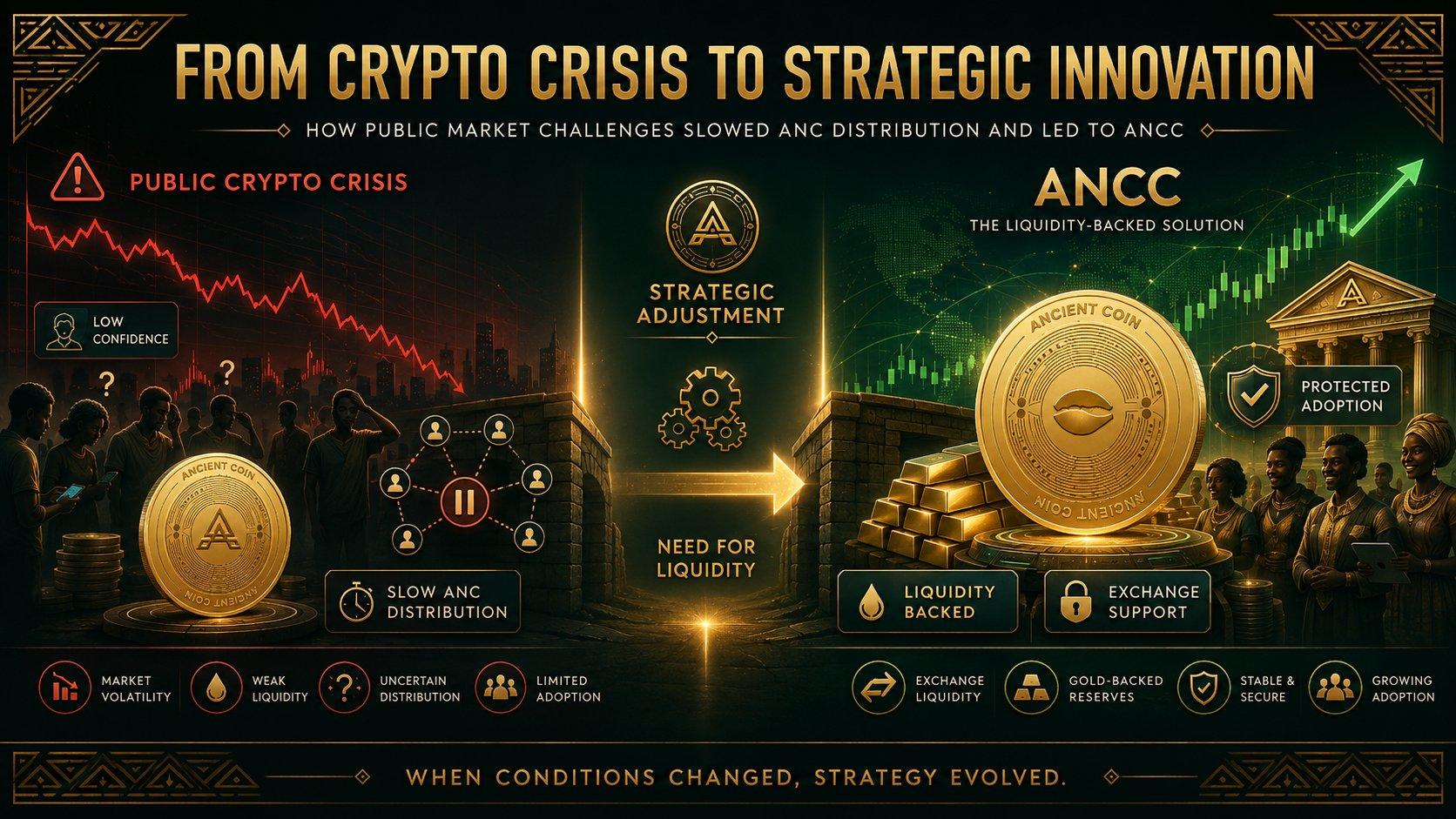
The cryptocurrency market experienced a significant downturn after the major bull market of 2020 and 2021.
By 2022, many cryptocurrencies had depreciated considerably. Investor confidence had weakened, enthusiasm had declined, and people had become more cautious about acquiring unfamiliar digital assets.
This broader market condition reduced the excitement and momentum required for the rapid adoption of Ancient Coin.
Many distributors were unable to explain the Ancient Coin model clearly to new adopters.
Consequently, some people who received ANC returned to the Ancient Society community expecting to sell or swap it immediately through the main exchange.
However, the original ANC was not primarily designed as an exchange-traded asset. It was intended to operate as a medium of exchange that people could transfer based on trust, use to purchase goods and services, and trade through peer-to-peer arrangements.
The growing number of recipients seeking immediate exchange liquidity showed that the original concept had not been communicated effectively.
This created confusion and compelled the administration to reconsider the strategy.
Another major challenge was the absence of sufficient places where people could use Ancient Coin to purchase goods and services.
If cryptocurrency is to become money in the fullest sense, it must eventually function as a direct medium of exchange.
People do not normally sell their Ghana Cedis, Naira, CFA, Dollars, or other recognized currencies before paying school fees, purchasing food, or obtaining services. They spend the currencies directly because they are widely accepted.
When a digital currency must always be sold or swapped before it can be used, then it has not yet attained the complete practical status of money.
Ancient Coin had a promising economic concept, but people did not yet have enough opportunities to spend it directly. This caused many holders to seek conversion into currencies that were already accepted in everyday transactions.
The administration initially expected existing supermarkets, traders, merchants, and service providers to begin accepting Ancient Coin.
However, many business owners were understandably hesitant.
Consider a trader who imports goods from China. That trader may accept Ancient Coin from customers, but when the goods are exhausted, the overseas manufacturer may not accept ANC as payment for new stock.
The trader could therefore be left holding a large amount of Ancient Coin without a practical way to restock the business.
This exposed an important structural weakness in the original strategy.
Ancient Society could not reasonably expect external businesses to accept Ancient Coin before its own ecosystem had successfully demonstrated that the coin could function within a real commercial environment.
The Decision to Terminate the ICO
After carefully assessing these challenges, the administration concluded that immediate strategic adjustments were necessary.
The first major decision was to terminate the ICO.
This was a difficult sacrifice because the funds generated through the ICO had supported the administration, management, and technical development of the project. Ending the ICO meant reducing an important source of cash flow.
Nevertheless, protecting the long-term survival of Ancient Society was considered more important than maintaining short-term revenue.
The ICO was officially terminated in September 2023.
Since then, the administration has not continued selling regular ANC directly from the administration wallet.
Why Exchange Liquidity Became Necessary
The next major adjustment was to create a structure through which people who personally contributed funds to the main exchange could retain access to those funds through liquidity.
The administration understood that new adopters who had not participated in the original ICO needed to enter the project under a more protected arrangement.
When such users placed money into the exchange to acquire Ancient Coin, their funds needed to remain available in the liquidity pool so that they could later swap their coins if necessary.
The project also needed to protect the much larger population that had not yet adopted Ancient Coin.
Less than five percent of the total Ancient Coin supply had been distributed during the original phase. This meant that more than ninety-five percent of the supply, together with the overwhelming majority of future adopters, still remained ahead.
The future of the entire project could not be designed solely around the immediate expectations of the small percentage that had participated during the early stage.
Ancient Society therefore needed to establish an environment in which future users could adopt the project with confidence, knowing that funds deposited through the exchange would be supported by corresponding liquidity.
This necessity led to the creation of Ancient Coin Cashable.
What Is Ancient Coin Cashable?
Ancient Coin Cashable, abbreviated as ANCC, was introduced on the Ancient Blockchain as the liquidity-backed form of Ancient Coin.
ANCC is not an unrelated coin competing against ANC.
It is best understood as Ancient Coin with liquidity supporting it on the main exchange.
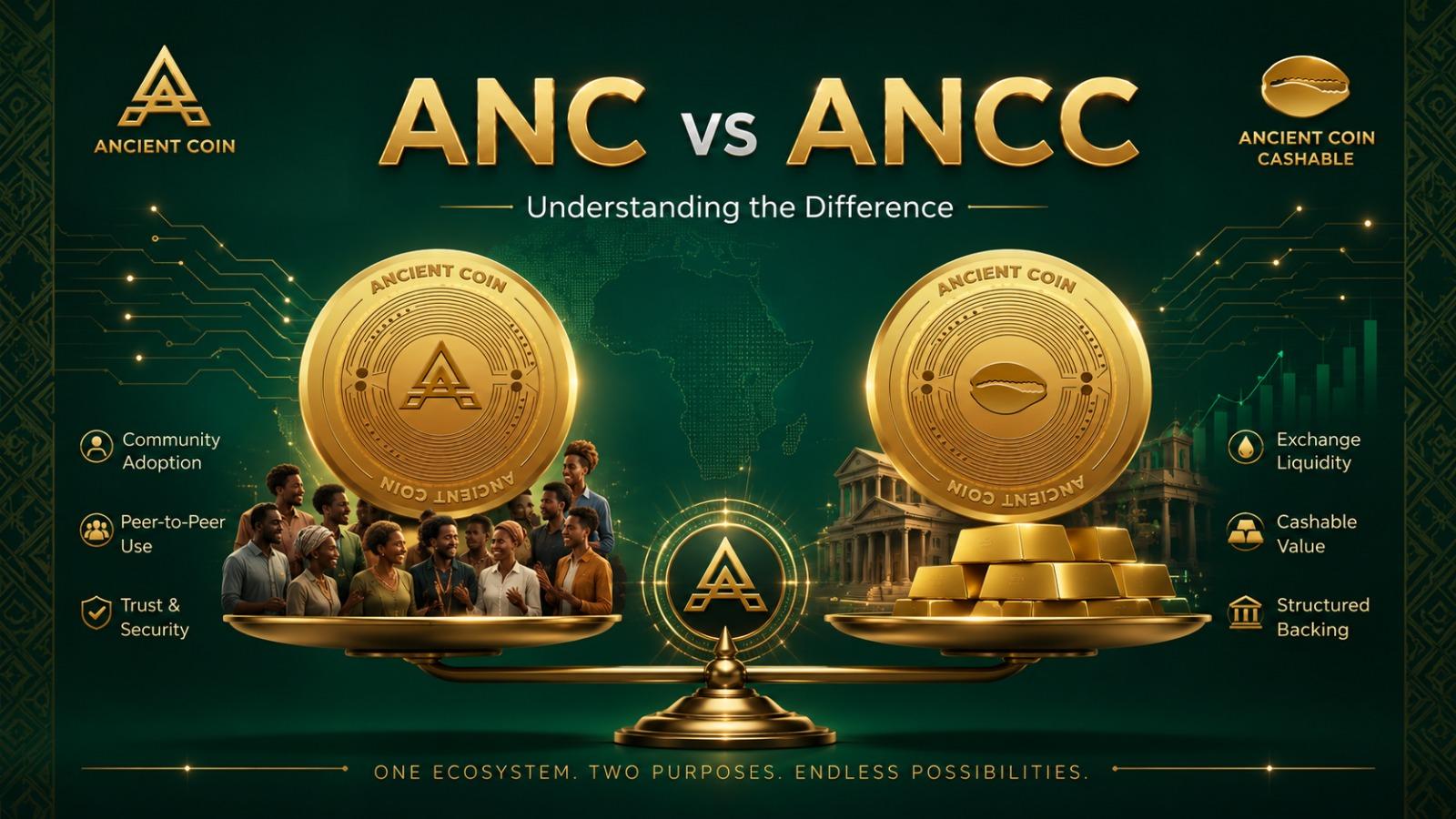
The principal distinction between ANC and ANCC is therefore based on how the coin was obtained and whether corresponding funds were deposited into the exchange liquidity pool.
When a person purchases Ancient Coin through the main exchange, the money deposited by that person enters the liquidity pool. The coin received by the buyer is therefore classified as Ancient Coin Cashable.
By contrast, Ancient Coin received through the original ICO, early community distribution, or an administration allocation without corresponding exchange liquidity remains Regular ANC.
The distinction can be summarized simply:
ANC is the original native coin of the Ancient blockchain.
ANCC is Ancient Coin supported by liquidity on the main exchange.
How ANCC Works
When a buyer acquires ANCC through the main exchange, the buyer’s funds are placed in the exchange liquidity pool.
The buyer may later return to the exchange and swap the ANCC according to the prevailing exchange rules and conditions.
This liquidity arrangement is what makes ANCC cashable through the main exchange.
However, the minting of ANCC does not increase the maximum supply of Ancient Coin.
Before the public distribution of ANC began, a total supply of 200 million Ancient Coins had already been minted.
To preserve this maximum supply, the Ancient blockchain was programmed so that whenever ANCC is minted, an equivalent amount of ANC is burned from the administration wallet.
If one ANCC is minted, one ANC must be burned.
If seventy ANCC are minted, seventy ANC must be burned.
This mechanism ensures that ANCC does not create additional coins beyond the established supply. Instead, part of the original ANC supply is converted into a liquidity-backed form.
The total supply therefore remains protected from inflation.
ANCC and the Ancient Ecosystem Reward System
The same principle applies when people earn rewards through Ancient Society applications.
When users accumulate qualifying stars, points, or other ecosystem rewards and convert them into ANCC, the Blockchain will mint the corresponding quantity of ANCC while burning an equal quantity of ANC.
This preserves the balance of the supply.
The Ancient ecosystem incorporates several reward structures:
Through participation, contribution, invitations, content creation, engagement, and other qualifying activities, users may accumulate rewards that can contribute to the wider distribution of ANCC.
A substantial portion of the remaining Ancient Coin supply is intended to reach the community through participation, rewards, mining-related activities, and engagement across the Ancient ecosystem rather than through direct sales from the administration.
Why Ancient Society Had to Build Its Own Ecosystem
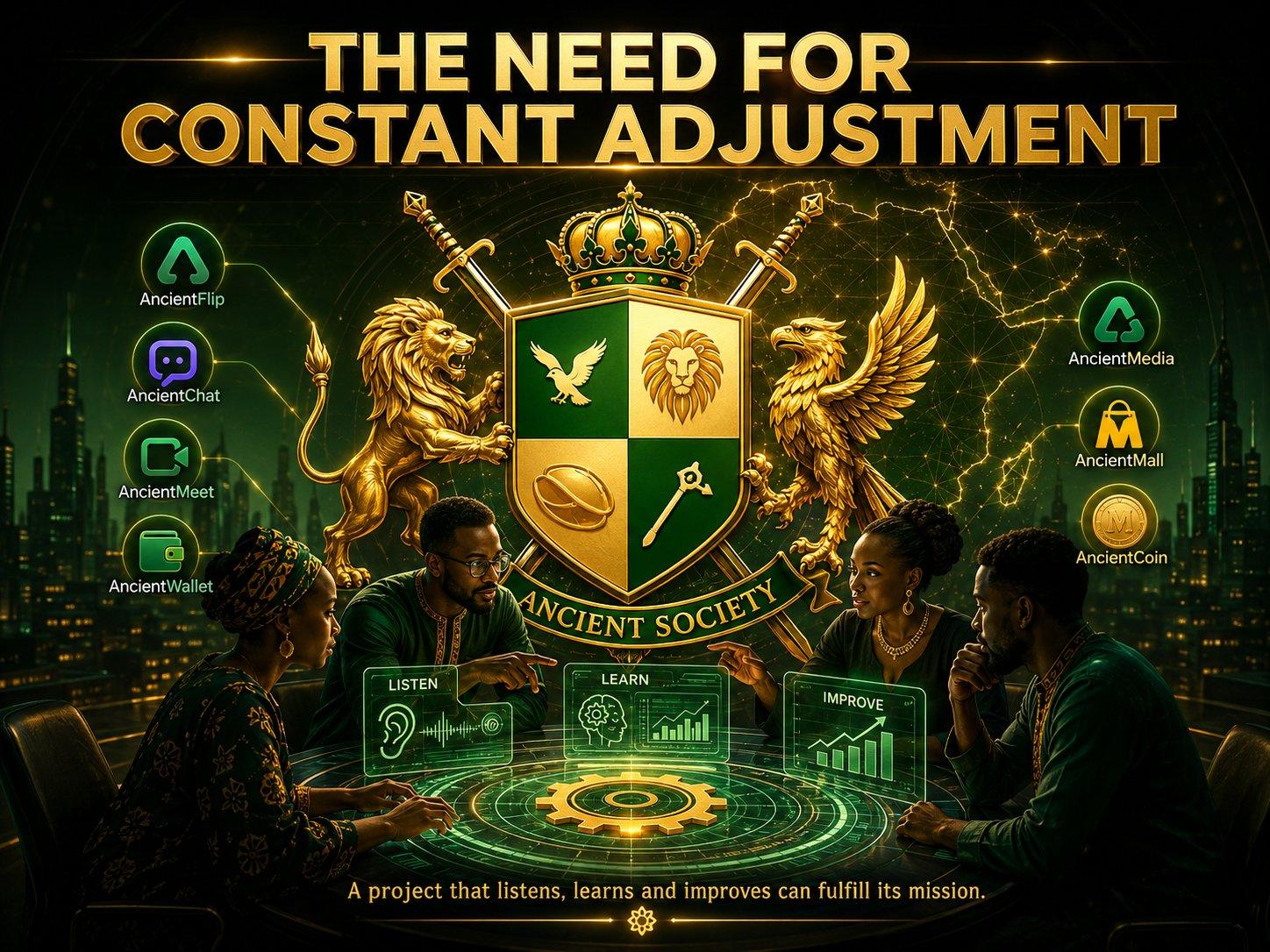
The difficulties encountered during the original Ancient Coin distribution phase compelled Ancient Society to accelerate the development of its own applications.
These include Ancient Chat, Ancient Media, Ancient Flip, Ancient Mall, Ancient Meet, Ancient Exchange (Main Coin Exchange and P2P), and the wider Ancient technology infrastructure.
The administration recognized that it could not reasonably expect outside businesses, supermarkets, software companies, and service providers to accept Ancient Coin before Ancient Society had demonstrated its usefulness within its own platforms in the Society.
The ecosystem must first prove that ANC and ANCC can function within communication platforms, marketplaces, meeting environments, social networks, media systems, reward programmes, and other digital services.
Once Ancient Society successfully uses Ancient Coin throughout its own ecosystem, it will be in a much stronger position to convince external businesses and institutions to consider accepting it.
The objective is to establish genuine utility.
Ancient Coin was not created merely to be bought, held, and sold as a speculative instrument. It is intended to function within a real economy.
Money must eventually be spent directly on goods and services. It should not always need to be sold before it becomes useful.
What Is the Fate of Existing ANC Holders?
Pioneers, distributors, and early ANC holders remain an important part of the Ancient Society journey.
They discovered the project before the majority of the public and accepted the risks associated with entering a new and developing system.
Pioneers in successful projects often receive significant long-term benefits. However, pioneering also comes with responsibility, patience, sacrifice, education, and labour.
Those who arrive first must often lay the foundation upon which future generations will build.
The fact that the original Ancient Coin strategy required adjustment does not mean that the project has failed or been abandoned.
Many cryptocurrency projects disappear when their original strategies collapse. In the case of Ancient Society, the leadership chose to pause, examine the weaknesses, restructure the system, strengthen the ecosystem, and introduce a more sustainable liquidity model.
Existing ANC holders should therefore understand that their coins remain part of the original Ancient Coin supply.
The long-term objective is to create conditions under which ANC can be converted into ANCC through an approved conversion arrangement.
However, such a conversion must be implemented responsibly. It can only take place when sufficient liquidity, adoption, utility, public confidence, and ecosystem activity have been established.
When Will ANC Be Converted Into ANCC?
The timeline depends greatly on the collective effort of the community.
The administration cannot build the required liquidity, adoption, and confidence alone.
If members, leaders, developers, distributors, and supporters actively participate in expanding the ecosystem, attracting users, strengthening the platforms, educating newcomers, and supporting exchange liquidity, the process can move forward more quickly.
Reaching at least one million holders would represent a major turning point for the project.
At that level of adoption, the path towards stronger liquidity, greater utility, and a structured ANC-to-ANCC conversion process could become considerably clearer.
It would therefore be irresponsible to promise a fixed conversion date before the necessary conditions have been achieved.
The speed of progress will depend on the seriousness, unity, participation, and collective labour of the community.
Can People Still Buy ANC From the Administration?
No.
The opportunity to acquire ordinary ANC directly from the administration ended in September 2023. Since that time, ordinary ANC has not been released from the administration wallet for direct public sale or reward of any kind.
New users who want a liquidity-backed form of Ancient Coin should acquire ANCC through the official exchange or earn qualifying rewards through the Ancient ecosystem which will intend be used to mine the ANCC
Can Someone Accept ANC From a Distributor?
A person may independently decide to accept ANC from an existing holder, provided that the person completely understands the difference between ANC and ANCC.
However, ordinary ANC obtained from a distributor is not automatically cashable through the main exchange.
Such ANC may only be traded through an approved peer-to-peer (P2P) arrangement unless and until a formal conversion mechanism is introduced.
The administration therefore encourages distributors to exercise patience and, where possible, continue holding their ANC until the wider conversion structure is ready.
The most important principle is transparency.
No newcomer should be given the impression that Regular ANC can presently be exchanged through the main liquidity-backed exchange in the same manner as ANCC.
Every person accepting ANC must first understand its present conditions and limitations though it still remain the original Native coin of the Ancient Blockchain
Why ANC Transfers May Be Restricted
To prevent a repetition of the confusion that followed the original ICO, the administration decided to restrict the transfer of ANC from wallet to wallet until the wider public had been properly educated about the distinction between ANC and ANCC.
This restriction is intended to protect newcomers from receiving Regular ANC without understanding its liquidity limitations.
The administration must protect the interests of the future majority.
Less than five percent of the total supply was distributed during the original phase, while approximately ninety-five percent remained undistributed.
The future of the project must therefore accommodate the millions of people who may still join rather than being shaped entirely around the immediate desire of a small number of early holders to cash out.
The concerns of pioneers are recognized and respected. However, Ancient Society must establish a system capable of supporting both existing holders and future participants without destroying the project’s economic foundation.
Since direct wallet-to-wallet transfers of Ancient Coin are temporarily restricted, some members may wonder whether the Ancient P2P Exchange will also be closed or restricted.
The answer is no.
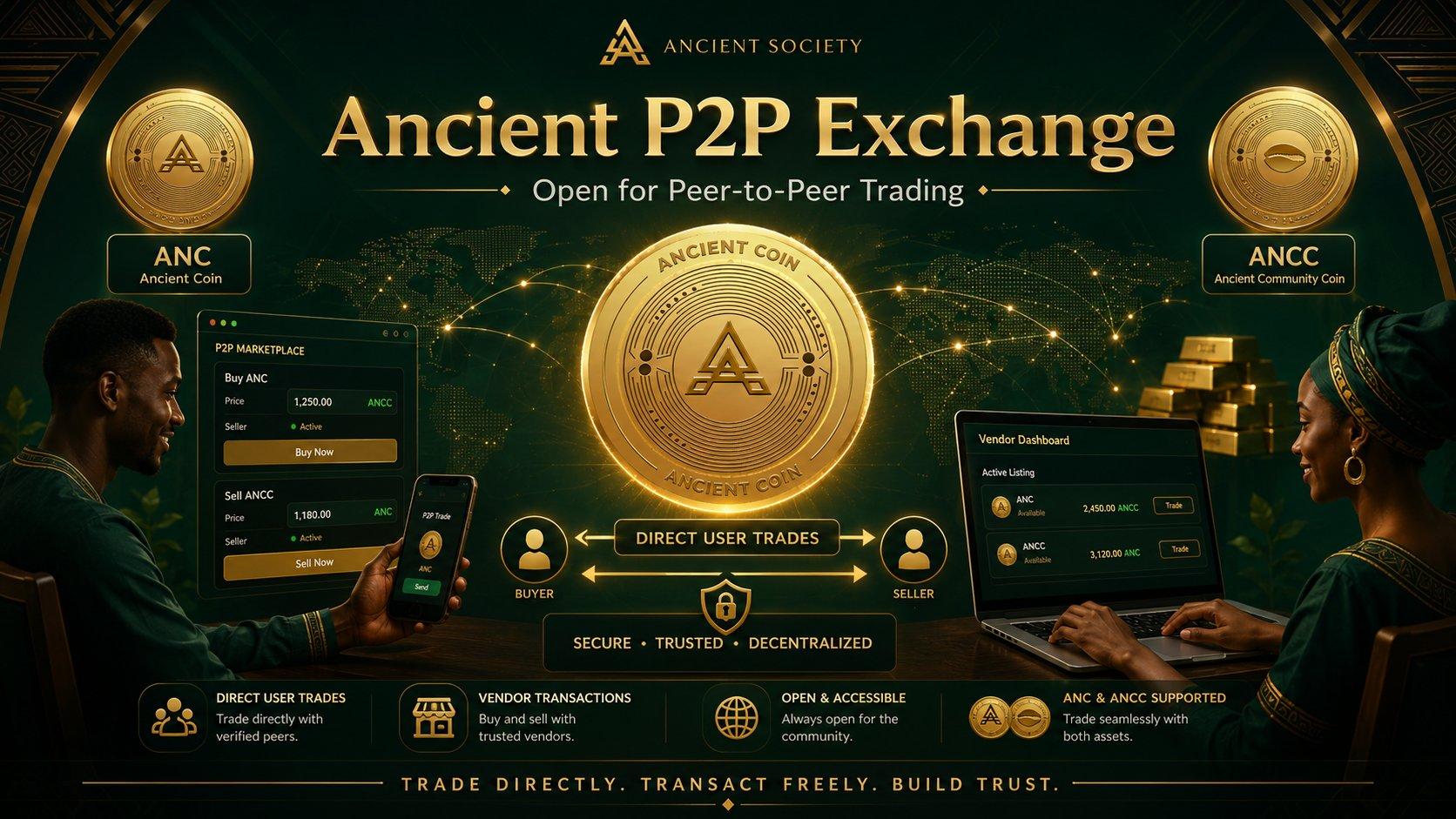
Both the Ancient Main Coin Exchange and the Ancient P2P Exchange will remain operational.
The Main Coin Exchange will continue to allow users to buy and sell Ancient Coin Cashable, abbreviated as ANCC. Because ANCC is supported by liquidity on the exchange, holders may swap it according to the prevailing exchange rules and conditions.
The Ancient P2P Exchange will also remain open for regular transactions involving ANC.
This is consistent with the original purpose of Ancient Coin. ANC was designed to function as a peer-to-peer medium of exchange. Holders should be able to use it to purchase goods and services from vendors who accept it. Where direct commercial use is not immediately available, holders may trade it with other users through the P2P Exchange.
The P2P platform was therefore created to facilitate transactions directly between buyers and sellers without placing responsibility for every exchange on the administration.
The temporary restriction on direct wallet-to-wallet transfers is not an attempt to control or confiscate anyone’s funds.
Its purpose is to protect newcomers and give the administration sufficient time to educate the public about the distinction between ANC and ANCC.
ANC is the original native coin of the Ancient blockchain and is not automatically cashable through the Main Coin Exchange. ANCC, by contrast, is supported by liquidity and can be bought or sold through the Main Coin Exchange under its applicable conditions.
Once sufficient public education and awareness have been achieved, the temporary wallet-transfer restriction may be lifted, allowing users to transfer their ANC more freely.
P2P trading remains open because a person who deliberately enters the P2P market to acquire ANC is expected to understand the nature of the transaction. Such a buyer knowingly purchases from another user rather than from the administration or the Main Coin Exchange.
When the buyer later decides to sell, the appropriate route is to return to the P2P market and trade with another willing participant. The buyer should not expect the administration or the Main Coin Exchange to provide liquidity for ANC obtained through a private P2P transaction.
This distinction helps reduce misunderstanding and prevents unnecessary pressure on the administration to exchange coins that were not acquired through the liquidity-backed system.
The temporary restriction on direct transfers also creates an opportunity to strengthen awareness, activity, and confidence around the Ancient P2P Exchange.
P2P trading is expected to play an important role in the future of the Ancient economy. As the ecosystem grows, the platform can facilitate the buying, selling, exchange, and commercial use of both ANC and ANCC.
The Ancient P2P Exchange is also not limited to Ancient Coin. It supports transactions involving ANC, ANCC, and selected Binance-related digital assets.
Closing the entire P2P platform merely because direct ANC transfers are temporarily restricted would therefore affect many legitimate transactions that are unrelated to the restriction.
For this reason, the Ancient P2P Exchange will remain open.
Anyone who voluntarily acquires ANC through the P2P route must do so with a clear understanding that the coin is not automatically cashable through the Main Coin Exchange. Any future sale or exchange should ordinarily take place through the same peer-to-peer market, unless an official ANC-to-ANCC conversion programme becomes available.
The Responsibility of Pioneers and Distributors
Pioneers and distributors should not attempt to outsmart the system or weaken public confidence in the project.
Ancient Society has grown far beyond its original identity as a cryptocurrency initiative.
It is developing into a structured Pan-African digital economy with communication platforms, media applications, meeting technology, short-form video services, marketplace systems, reward structures, financial infrastructure, and community-development programmes.
Technology platforms can survive without Blockchain when they solve genuine human problems.
The Blockchain strengthens this wider structure, but the entire Ancient Society project must not be viewed only through the narrow question of immediate coin liquidity.
Pioneers therefore have a responsibility to create an enabling environment in which newcomers can study the history, understand the adjustments, ask meaningful questions, and participate with accurate information.
How the Community Can Help Build Liquidity
Liquidity remains central to the future transition from ANC to ANCC.
Members who understand the structure, may support the liquidity pool by acquiring ANCC through the official exchange according to their own financial capacity.
When more people acquire ANCC through the exchange, more liquidity enters the system.
ANCC holders may then access the exchange without requiring special permission from the administration or someone.
Members can also contribute by actively earning stars, points, rewards, discounts, and coins across the Ancient ecosystem.
They can invite new users, promote the platforms responsibly, educate others, create content, support community programmes, and participate in the different applications.
The wider the participation, the stronger the potential foundation for future distribution, utility, liquidity, and ANC conversion.
The African Millionaire Grooming Hub
Members are also encouraged to participate in the African Millionaire Grooming Hub, abbreviated as AMGH, whenever membership opportunities are opened.
The African Millionaire Grooming Hub is being developed as a long-term wealth-development initiative with the stated objective of helping committed participants work towards becoming millionaires by 2035.
The educational books have been prepared, the supporting software has been developed, and plans are being made for regional, state, provincial, and local mobilization tours across Africa.
The initiative aims to reach at least one million members.
Rather than standing at the fence and waiting passively for ANC liquidity, community members are encouraged to participate in building the knowledge systems, technology platforms, businesses, communities, and liquidity required for collective success.
The benefits of Ancient Society must emerge from the labour, commitment, sacrifice, resources, and determination of the people who build it.
Ancient Society Is Different From Privately Owned Projects
Ancient Society must not be evaluated in exactly the same manner as projects financed by wealthy individuals, private corporations, venture capitalists, or a small group of founders.
It was established as a community-driven Pan-African project.
Its development strategy must therefore also be community-driven.
The people cannot expect a small administration to finance, develop, market, educate, manage, and expand the entire ecosystem alone.
Country leaders are therefore encouraged to ask questions whenever they do not understand a policy, decision, or strategic adjustment.
Questions create clarity. Constructive dialogue strengthens leadership. Conflict without understanding weakens the entire system.
Members are equally encouraged to rally behind responsible leaders and contribute constructively to the development of the Ancient ecosystem.
A Message to Country Leaders
No outside population will build Ancient Society in another country.
The success of Ancient Society in Ghana will depend significantly on Ghanaians.
Its success in Nigeria will depend significantly on Nigerians.
Its success in Cameroon will depend significantly on Cameroonians.
The same principle applies to every African country and every diaspora community.
It is possible that within five or ten years, one country may have a strong and functional Ancient ecosystem while another country may still have little understanding of the project.
The difference will depend on leadership, education, organization, participation, unity, and local commitment exhibited by the people of that country.
Every country must accept responsibility for building Ancient Society within its own territory.
A Message to Newcomers
New members are entering the project at an important stage.
They have the opportunity to study the system, examine its history, ask questions, understand the distinction between ANC and ANCC, evaluate the wider ecosystem, and decide how they wish to participate.
They should conduct their own research and seek clarification wherever necessary.
At the same time, they must understand that opportunities develop and change with time.
Ancient Society believes it is building a promising Pan-African technology and economic ecosystem.
Each person must decide whether to contribute to its development or remain at the fence and watch others build it.
Ancient Society Is More Than a Cryptocurrency Project
Ancient Society has outgrown the boundaries of a cryptocurrency initiative.
It is developing into a continental technology, economic, and empowerment mission.
Its broader objective is to reduce Africa’s dependence on foreign-controlled digital platforms, financial systems, communication infrastructure, social networks, marketplaces, and data ecosystems.
Ancient Society seeks to contribute to Africa’s technological independence by building African-owned platforms capable of solving both African and global problems.
From this perspective, Ancient Coin is not the entirety of Ancient Society.
It is one important component of a much wider architecture.
The applications, community, marketplace, reward systems, communication platforms, leadership structure, educational programmes, wealth-development initiatives, and vision of African digital independence must all be understood together.
Ancient Society has become a continental rescue mission: an effort to contribute to Africa’s technological awakening, economic dignity, data ownership, and liberation from excessive dependence on foreign technology.
Conclusion
The difference between ANC and ANCC can now be stated clearly.
ANC is the original native coin of the Ancient Blockchain. It includes coins distributed through the original ICO, early community distribution, and other allocations that were not individually backed by liquidity deposited into the main exchange.
ANCC is the liquidity-backed form of Ancient Coin. It is created when qualifying liquidity or ecosystem rewards support its issuance.
Whenever ANCC is minted, an equivalent amount of ANC is burned so that the established maximum supply remains protected.
ANC holders remain pioneers of the Ancient Society project. However, pioneering requires responsibility, patience, sacrifice, education, loyalty, and active participation.
ANCC provides a more protected liquidity pathway for new adopters while the wider Ancient ecosystem continues to grow.
The future conversion of ANC into ANCC will depend on the establishment of sufficient liquidity, adoption, utility, public trust, ecosystem strength, and collective participation.
Ancient Society cannot be built by one person.
Long Live Ancient, Long Live Africa and Long live Humanity.